Turning AI capabilities into useful business products.
- Project
- Consent · AI Products
- Role
- Founder · Product, Design & Engineering
- Year
- 2025 — Present
- Platform
- Web · Shopify App · Salla App
Context
Every business can now access frontier AI models. Very few can turn that access into a product a customer would pay for. The distance between a capability and a product is strategy, design, trust, and operations — the unglamorous majority of the work.
Problem
Commerce businesses need a constant stream of product imagery, and AI can generate it — but naive generation creates real problems: inconsistent quality, brand risk, and unresolved questions about the real people whose likenesses AI imagery touches.
The product opportunity was to solve the whole problem — quality, workflow, and the human side — not just to wrap a model in a UI.
My Role
Consent is my own product. I own it end to end: product strategy, experience design, engineering, billing, compliance, and operations.
- Product strategy and positioning
- Full product and UX design
- Engineering with AI-assisted development (Claude Code)
- Generation quality pipeline — prompt architecture, realism, safety
- Model consent and compensation framework
- Commerce distribution — Shopify and Salla apps
Strategy
Two convictions shaped the product. First, quality is a pipeline, not a prompt — reliable output comes from layered prompt architecture, sanitization, and review, not from asking a model nicely.
Second, trust is the product. AI imagery that touches real people's likenesses needs explicit consent, fair compensation, and the right to withdraw — designed into the system, not bolted on as a policy page.
Product Approach
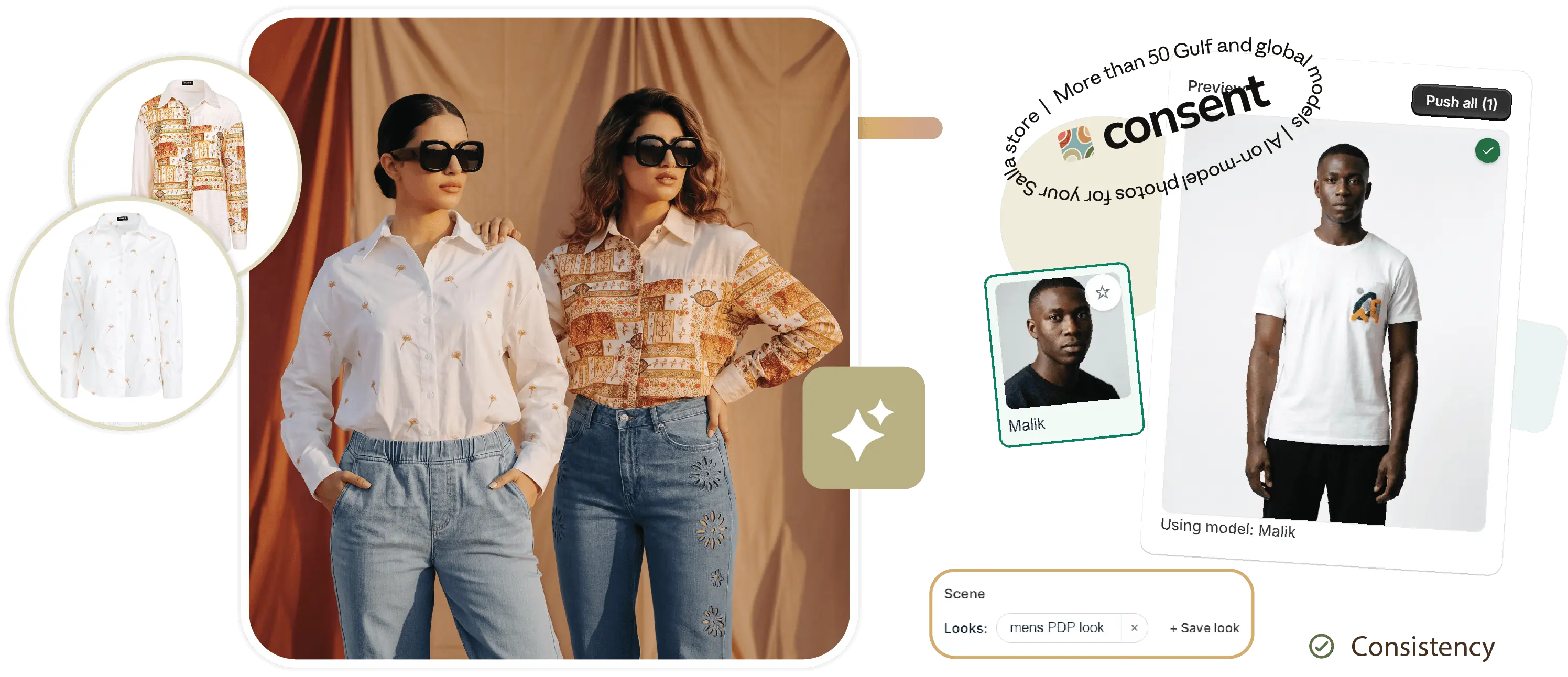
The consent framework treats the humans in the system as first-class users: explicit consent terms, configurable revenue share, and a wind-down period when a model withdraws — enforced by the platform itself.
The generation pipeline layers business logic over the models: structured prompt construction, a realism layer, sanitization, and auditability — so output quality is an engineered property, not luck.
Experience Design
The product is designed for merchants, not ML enthusiasts. No prompt boxes as a primary interface — structured creative controls that speak commerce language: product, model, scene, format.
Implementation
Built and operated as a real business: subscription billing, quota management, and an admin operations layer — with distribution where merchants already work. The Shopify app is live in the Shopify App Store; the Salla app is in pre-launch.
The codebase itself is a case study in AI-assisted engineering — built with Claude Code under human product direction, which is exactly the human-in-the-loop discipline the product preaches.
Outcome
A live, revenue-generating product with a published Shopify App Store listing and a compliance framework covering every person whose likeness the platform touches.
Pending verification[ADD VERIFIED METRICS — subscribers, generation volume, or merchant outcomes when ready to publish.]
Reflection
Building an AI product end to end — strategy, design, code, billing, compliance — is the strongest proof I can offer that I understand how AI becomes a business, not a demo. That understanding transfers directly to client and employer problems.
Contact
Have a business or product challenge worth solving?
Tell me what you’re building, transforming, or trying to improve.