Owning the systems a 10-branch restaurant network used to rent.
- Impact
- 2× sales · 5× lower cost
- Project
- Awal & Tali
- Role
- Product Design & Build
- Year
- 2026
- Platform
- Custom RMS · Customer Ordering App
Context
Awal & Tali is a Saudi cuisine restaurant network with more than ten branches. For years the operation ran on a well-known commercial restaurant management system — a reasonable choice at three branches that became an expensive one at ten.
Problem
Two costs grew with every new branch. The RMS was licensed per branch, so every opening raised the software bill again — a recurring tax on growth. And delivery ran through aggregators, whose commission took a share of every order.
The network had reached the size where renting its core systems no longer made sense. It needed to own them.
My Role
I own the product end to end — from understanding how the branches actually work, through designing the workflows and interface, to building and iterating on the working software.
- Operational discovery across branches
- Workflow and process design
- Product design and design system
- Custom RMS build (TalabOS)
- Customer ordering app
- Iteration with real branch staff
Strategy
Replace the rented core with an owned one. A purpose-built RMS costs once and serves every current and future branch — turning a per-branch subscription into an asset that gets cheaper with scale, not more expensive.
Same logic on the revenue side: a direct ordering app keeps the customer relationship — and the margin — that aggregators were taking. And start at the counter: the cashier experience is used hundreds of times a day and decides whether the rollout survives.
Product Approach
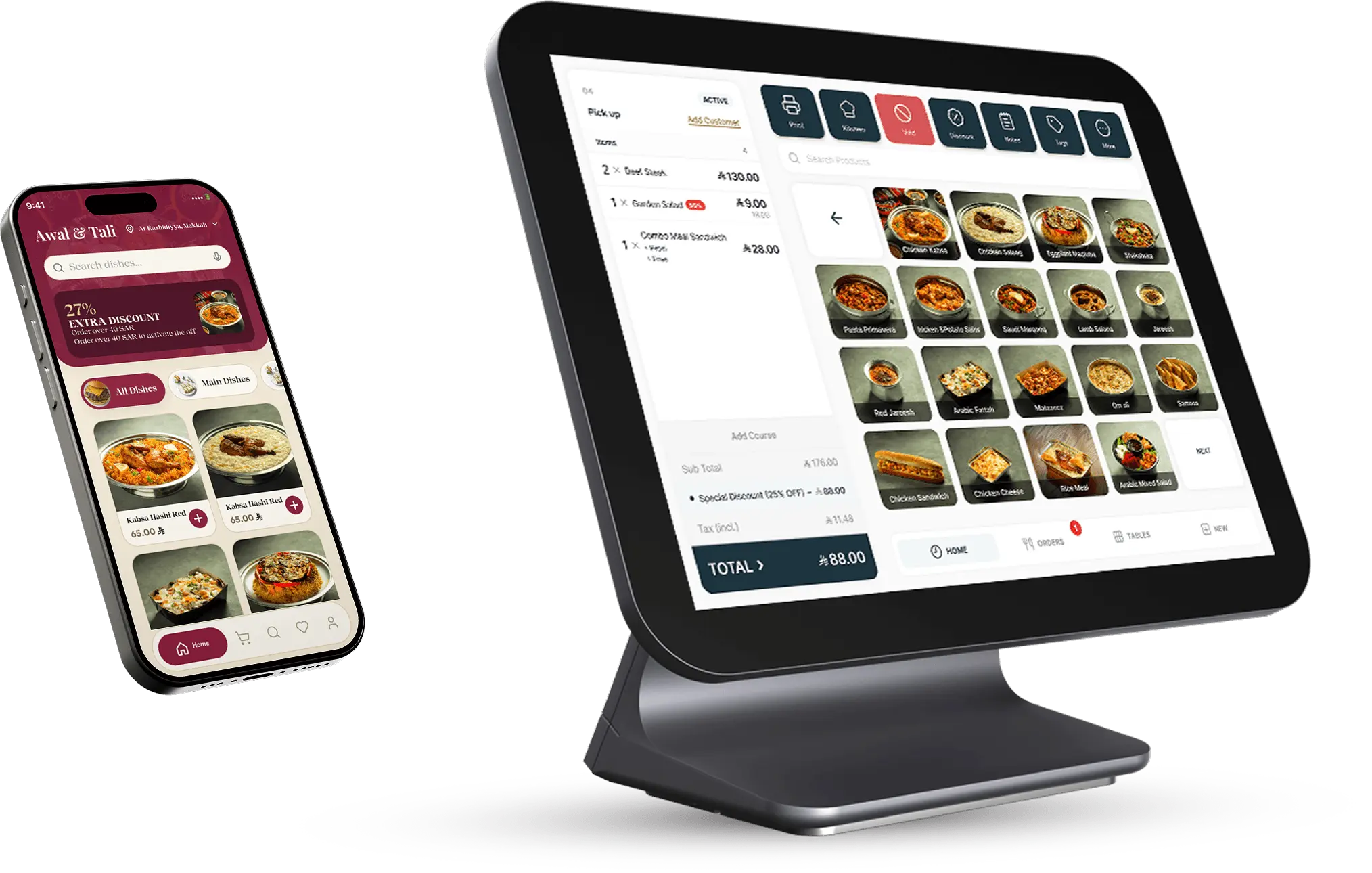
TalabOS — the network's own RMS — models how the branches genuinely operate rather than forcing them into a generic POS template. Order flow, modifiers, and daily routines reflect the observed reality of the counters, not an idealized process diagram.
Alongside it, a customer mobile app for direct ordering — shifting delivery volume from commission-charging aggregators to an owned channel.
Experience Design
The interface is Arabic-first and built for speed: large touch targets, minimal depth, and states designed for interruption — because at a real counter, every task gets interrupted.
Dialogs, edge cases, and failure states were designed deliberately in Figma before build, so the app degrades gracefully instead of surprising staff mid-shift.
Implementation
Built as a single cross-platform codebase with Expo (React Native), which keeps the branch hardware options open and the iteration loop short — a design change can reach a real counter the same day.
Outcome
Sales doubled, and system costs fell to a fifth of the licensed setup. The software bill stopped scaling with branch count — every new branch now runs on infrastructure the network owns — and direct orders keep margin that aggregator commissions used to take.
Reflection
There is a size at which renting core systems flips from smart to expensive, and most operators pass it without noticing. The 5× cost reduction wasn't a software achievement — it was a business decision, executed as product. That's the altitude transformation work should happen at.
Contact
Have a business or product challenge worth solving?
Tell me what you’re building, transforming, or trying to improve.